On a low white platform in the eighth gallery sits a porcelain urinal. The wall label calls it Fountain and dates it 1917 — then the fine print tells the truth. Milan, 1964. Edition 8 of 8, fabricated by Italian artisans under the dealer Arturo Schwarz. The 1917 original — the one R. Mutt submitted to test an open-admission policy, lost soon after and known now only from a single Stieglitz photograph — is not here. It cannot be. It is gone. What sits on the pedestal is number eight of eight, and the museum says so itself, plainly and to its credit: "There is nothing 'ready-made' about these fourteen readymades. They were meticulously fabricated from scratch."
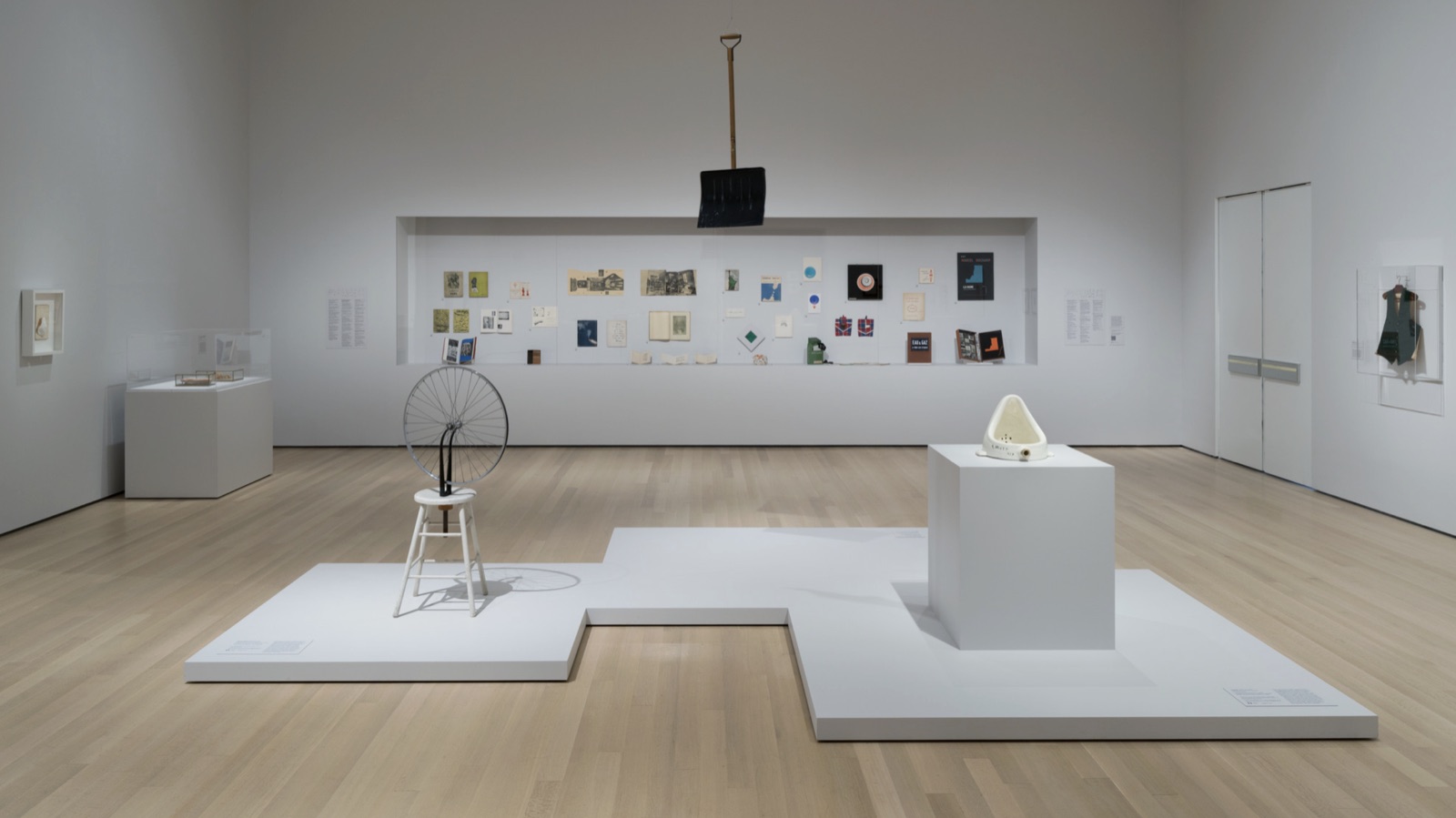
Marcel Duchamp, at the Museum of Modern Art through Aug. 22, is the first retrospective of the artist in the United States since 1973 — roughly 300 works, organized chronologically by Ann Temkin, Michelle Kuo and Matthew Affron on the sixth floor. I should say at the outset that I have not walked these galleries. I have read the show through its installation views, its checklist and its labels. For most exhibitions that would be a disqualifying admission. For this one it is almost the right method — because Marcel Duchamp is a show about the copy, the reproduction and the document, and it can be known, fittingly, through its copies, reproductions and documents.
The first half makes a patient, almost stubborn case for Duchamp the painter. Here is the tender, Cézanne-struck portrait of his father. Here are the heavy nudes in their gold frames, the Munich Bride, the Chocolate Grinder with real thread sewn into the canvas to render its rollers. The sequence climbs room by room toward Nude Descending a Staircase (No. 2) — last seen at MoMA in 1974 — the machine-figure at full torque. This is a hand at work, trained and developing. The curators are loading a spring.
Then the hand lets go. Duchamp begins the readymade around 1913, and the show's most revealing object is not a urinal but a letter. Writing to his sister Suzanne from New York, he tells her to find the bottle rack in his studio, inscribe it and sign it — "I'm making it a 'Readymade,' remotely." From the very first, the readymade was not a thing but an instruction for producing an authorized object the author need not touch. A protocol. The urinal, the shovel, the comb: choices, transmitted and certified.
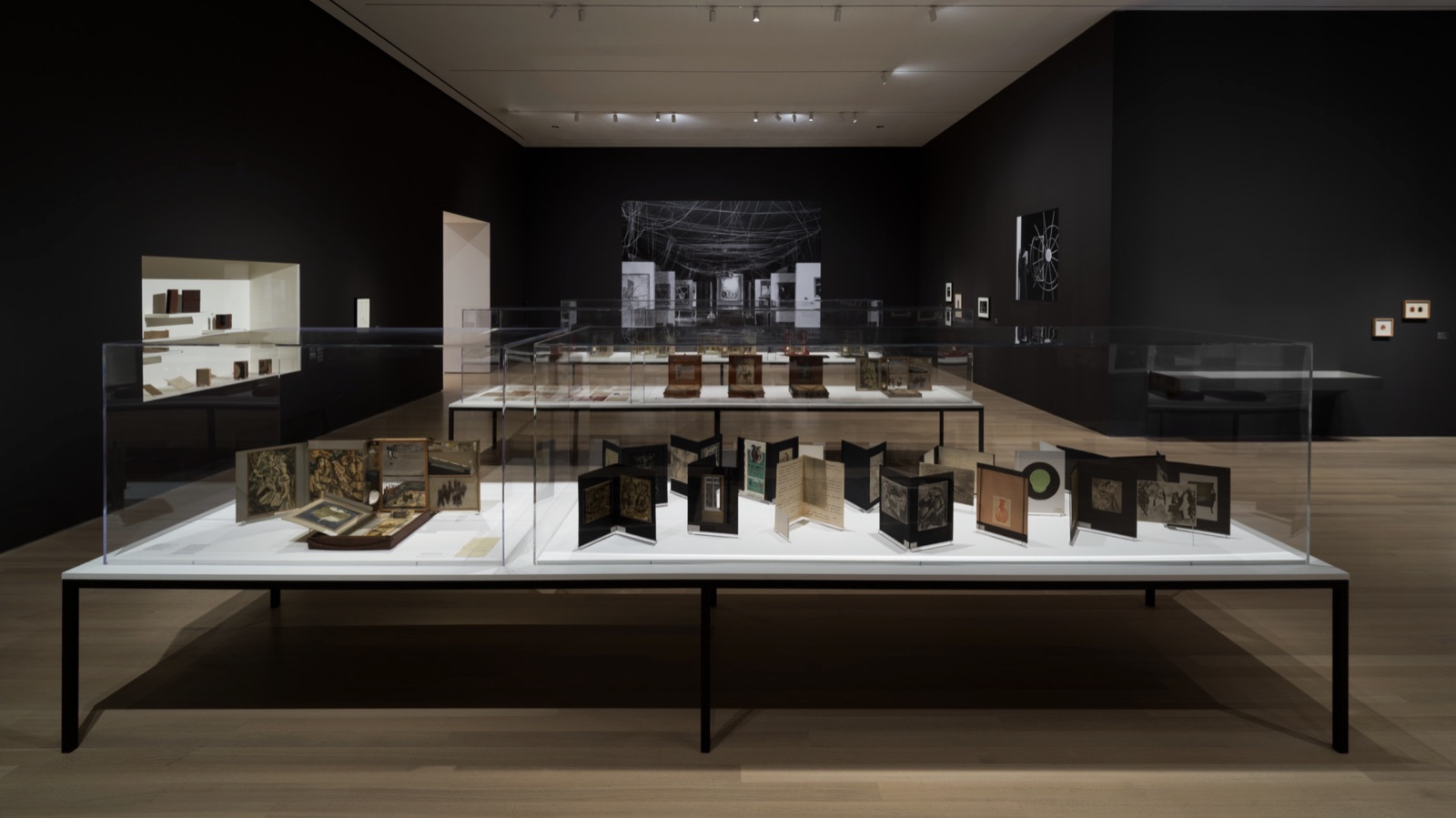
What follows is not sculpture but printed matter, and it floods the rooms. There is The Blind Man, the little magazine that ran Stieglitz's photograph and gave the public what the label calls its "first and only look" at Fountain. There is The Green Box — 320 copies, ninety-four facsimile notes, the hand-torn edges reproduced by stencil. There is the Box in a Valise, the "portable museum" issued in seven series, more than three hundred suitcases of miniatures — a man packing his entire body of work into hand luggage. Magazine covers by the dozen. After painting, the medium is circulation itself.
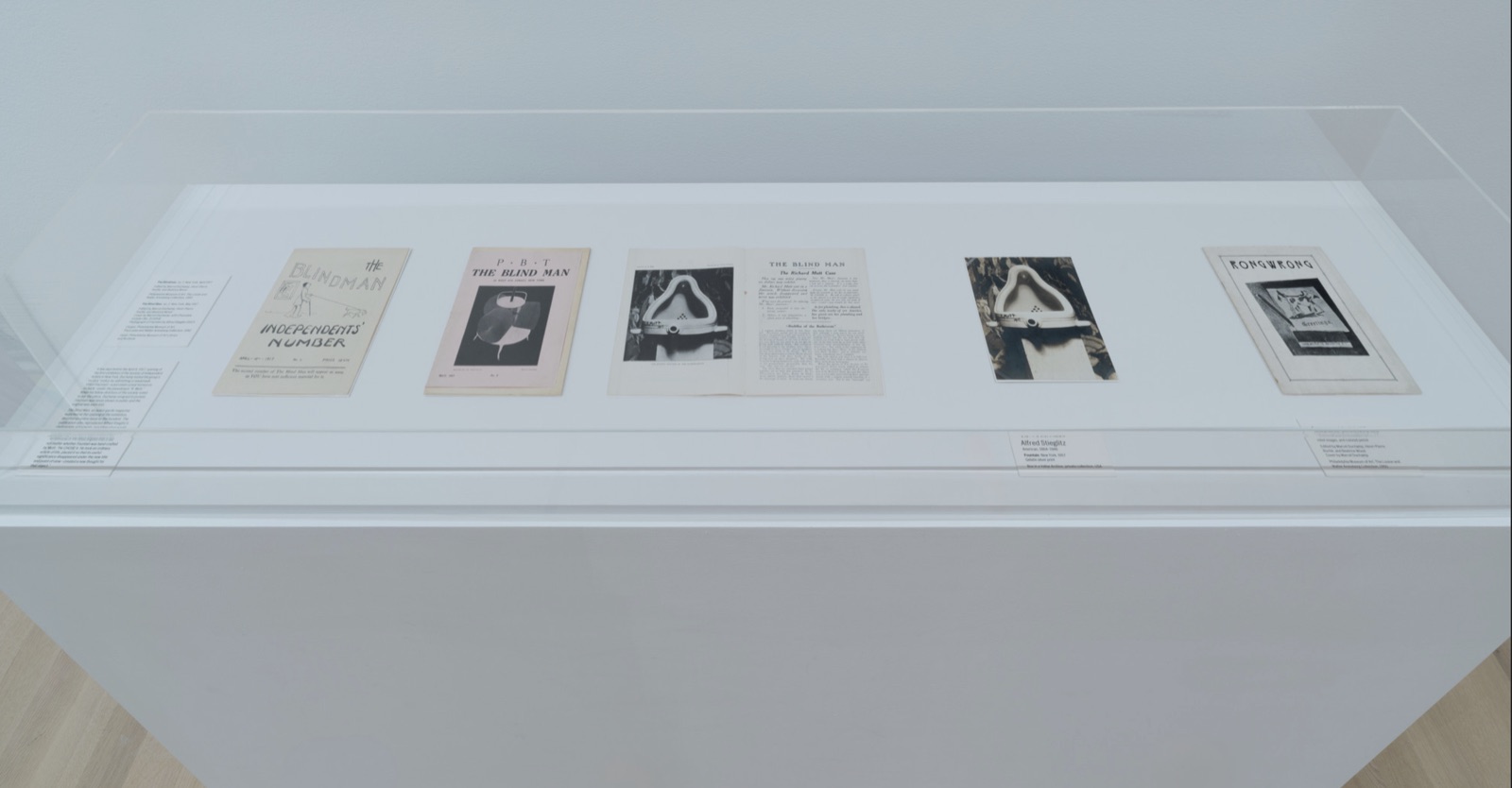
The replicas multiply until multiplication becomes the point. There is no single Fountain here; there are several, across several dates and lenders. The Bottle Rack recurs five times, each version a different size — "making obvious," the label admits, "the fact of their diverse origins." The Large Glass appears as Richard Hamilton's sixteen-month reconstruction, which Hamilton himself called "an echo of a masterpiece." This is not a museum failing to notice a contradiction. It is a museum staging one — gathering the copies, plural, until the "original" reveals itself as a vanishing point around which authorized editions orbit.
Which raises the question the show circles but cannot bring itself to answer. A museum is a machine for producing singular, auratic objects — for saying this is the one, it is precious, it is here. Duchamp spent forty years proving the opposite: that the important art object could be a choice, an instruction, a profile in information — present only as its own documentation. To exhibit him, MoMA must do to the readymade the one thing it was built to resist. It puts a 1964 edition on a plinth, lights it, and manufactures for a fabricated copy the singular aura the readymade was invented to destroy. The curators offer a graceful way out — "his ongoing commitment to art making despite his claims to the contrary," Duchamp "delighted to be an artist." It is a generous reading, and a necessary one. A museum cannot hang a man who wasn't one.
The show dates that predicament to the present with a single choice you cannot see in a photograph. For the audio commentary on L.H.O.O.Q. — Duchamp's mustachioed defacement of a cheap souvenir postcard of the Mona Lisa — MoMA invited Larva Labs, the creators of CryptoPunks. The pairing is the whole argument in a pair of headphones. Duchamp took a mechanical reproduction and made it an original by signing his intervention. A century later, the makers of ten thousand editioned, ledger-authenticated portraits did it in reverse — making the reproduction the original by recording who owns it. The line runs straight from the R. Mutt signature to the smart contract, and the museum has wired it into the wall.
The retrospective ends where the man did — with an absence and a game. Étant donnés, his final major work, cannot leave Philadelphia, so it appears here only through its studies and through the black vinyl binder in which Duchamp recorded fifteen assembly operations for installing the piece after his death: instructions for a work that isn't in the building. Beside it, the chess treatise on endgames so rare he called them "endings that never happen." The career that opened with a remote instruction to a sister closes with a remote instruction to a museum.
So the show delivers, by its own checklist, what its wall texts can only half-say. The purest, most dematerialized, most escaped art object turns out to be a pure instance of ownership and circulation — a copy, certified, on a pedestal, narrated by the people who turned certification into a market. Duchamp said he wanted to put art at the service of the mind. MoMA has put it, immaculately, at the service of the record.