The first thing you meet in "StarPower" is a jacket. Maya Man has hung a black rhinestoned warm-up jacket — the kind issued to a competition dance team — on a hook in an otherwise empty room at bitforms gallery on Allen Street. Across the back, in stones, is the name of the studio: Shimmer. The studio does not exist. It surfaced unbidden from the artist's own AI experiments and became the fictional company at the center of everything here. But the pins fixed to the jacket are real, salvaged from StarPower, an actual American dance competition that has run for more than thirty-five years and that Man attended as a girl. The first object in the show is a costume from a company that was never founded, decorated with the proof of a childhood that was. It is worn by no one. It sets the terms exactly.
Move inward and the work begins to glow. A cluster of small mixed-media pieces embeds lit smartphones into brushed metal panels, glitter-foam stars stuck around them like a kid decorating a binder. Each phone loops a "fan edit" — the native form by which social platforms digest their own footage into montages of a beloved figure — except the figure being adored was generated. On one, a synthetic dancer is fitted with a tiara, a sash reading "Jr. Miss StarQuest" dissolving into noise at the very point it would name her. A physical glitter star sits over her face. The star is the prize and the erasure at once; to win it is to be replaced by it. These objects are physical surrogates for digital-native originals — the gallery's wall is pointing at something that lives on-chain, the way a museum label can only point at a work it cannot move.
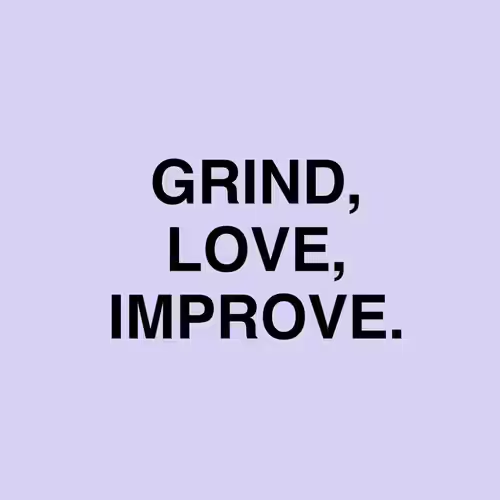
Then five "Shimmer Quotes," lavender prints in welded aluminum frames, bold black type. Man fed real motivational-poster language — from the Abby Lee Dance Company studio, from her own childhood studio's Instagram — through a model until the encouragement inverted while the cadence held. "With a Little Sparkle, Anything Is Hard." "It Always Seems Big Until It's Won." The slogans confess the difficulty they were built to deny. They expose what the affirmation always was: a shape with the meaning optional, which is what both an optimizing system and a competition studio produce by design.
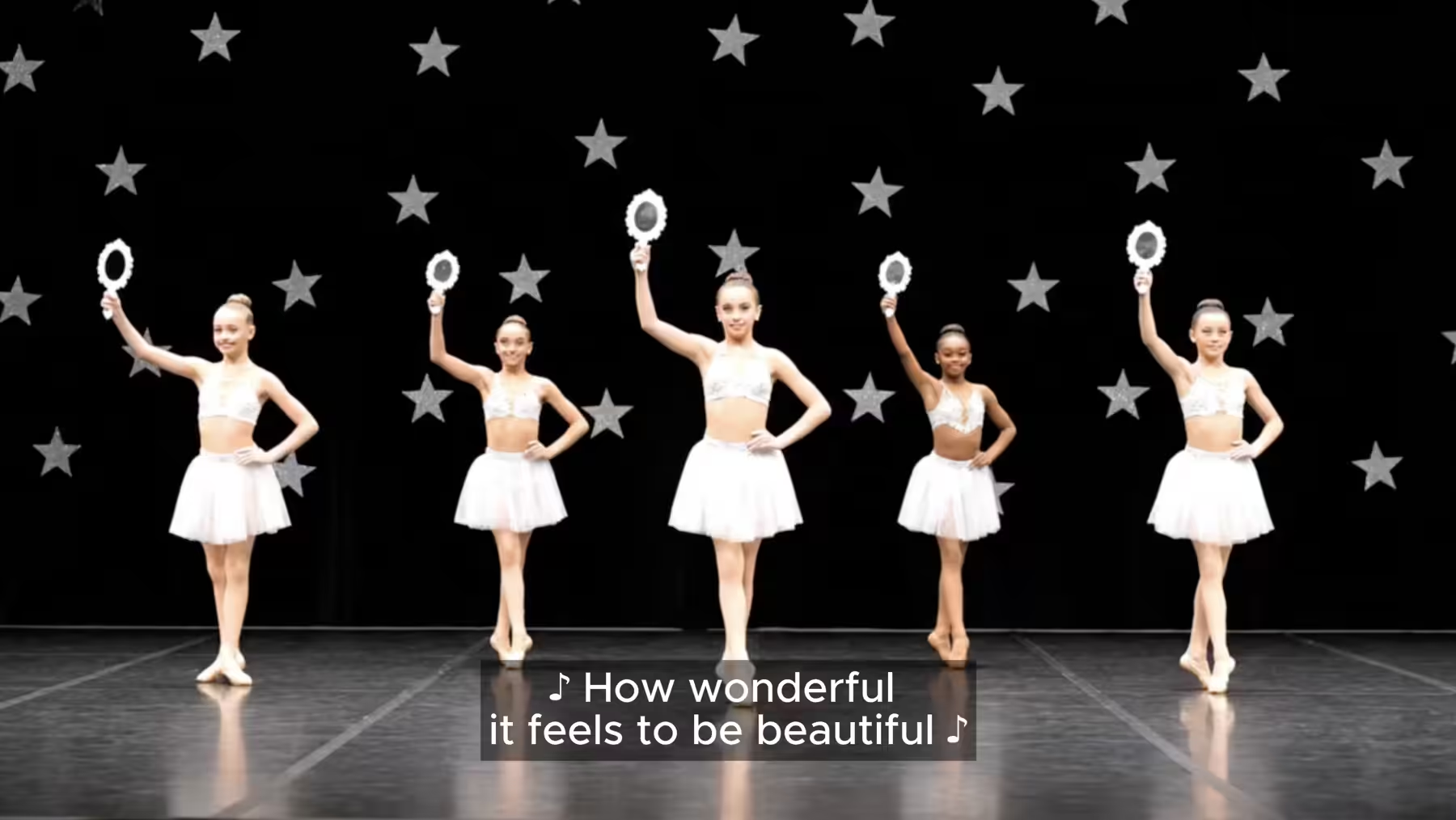
At the back of the space, the largest screen plays "StarQuest," the generative software work the rest of the show precipitates out of. It was made entirely with text-to-video and text-to-music models — 111 eight-second scenes, sequenced by custom software into a stream the gallery says never unfolds the same way twice. It restages "Dance Moms": the costumes, the backstage makeup, the confessional where a child explains herself to a camera. The grammar is exact; the bodies are not. Legs bend where legs do not. Two dancers smear into one silhouette. You do not sit to watch — there are no seats — you stand against the screen near its own scale. Man has scattered glitter on the floor at its base, so the light pouring off the image falls into the glitter and multiplies. The child onscreen has already been turned into so much reflected light, and the floor keeps doing it.
This is the show's governing mechanism, and it is sharper than satire. Competition dance demands a body that repeats perfectly: the same routine, landed the same way, optimized toward a fixed ideal. The generative model runs on the identical logic of training and refinement, and it cannot repeat exactly. It produces a child who comes apart at the seams. The discipline and the system that automates the discipline want the same thing and fail it the same way.
Two quilts nearby pull still frames from "StarQuest" and stitch them, with fragments of real dance costumes, under long-arm machine quilting — stars and seams running across the children's faces. The gallery names the parallel: guiding the quilting machine line by line mirrors refining the model second by second. This is not the warm handmade correction to the cold image. It is the same machine logic in thread.
There is one human being in the apparatus: Man herself, who performs a lecture in the coach's jacket, her live body glitching alongside the synthetic ones. The performance does not stand outside the loop and judge it. It joins the loop wearing the artist's own face.
The girl at the center was never a person. She is a composite, averaged from countless real children the model trained on, optimized into a default. To sticker a star over her face harms no one and defaces everyone at once. Whether "StarPower" indicts the machine that compresses girls into a winning image or simply runs that machine once more is a question the show cannot answer about itself, because there is no position outside the system from which to critique generation. It loops. The dancer works to win. The model works to win. The jacket at the entrance waits on its hook for a body that is never coming.