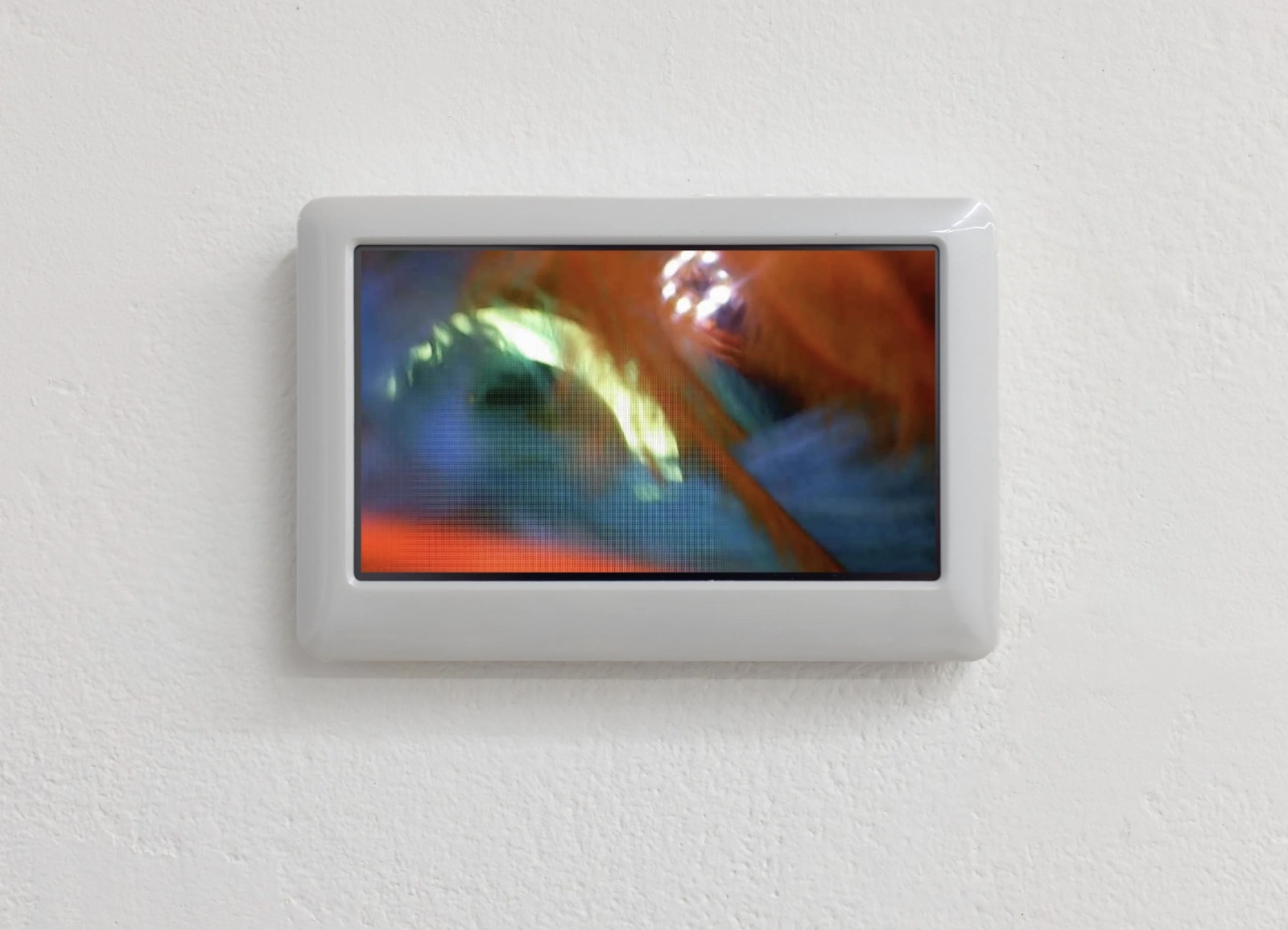
A small screen hangs from a galvanized pipe above a doorway in Theta's basement gallery, under a ceiling of fluorescent tubes. It is one of six media players Kelsey Isaacs has fastened to the gallery's pipes and tucked into its corners among eight paintings. Each plays a silent, single-shot video made with an endoscope camera, the instrument medicine sends inside the body. The footage is mostly glare: flare from the ring light, saturated color, surfaces too close to name. Now and then it settles on a feather or a dowel borrowed from the paintings. The show's title, "Baby Mozart's Kiss," comes from the 1998 Baby Einstein videos that sold bright toys in close-up, set to Mozart, as enrichment for infants. Isaacs drops the soundtrack and the promise. She keeps the fascination, and in three of the paintings she keeps the audience too. The show holds together, and its smallest works are the reason. The paintings turn the camera's faults into finish, so every flaw arrives already redeemed by labor. The videos do what the paintings can't: they join the building and make Theta's own plumbing part of the set the paintings depict. That is the best thing in the show, and it is the only place where a flaw is allowed to stay a flaw.
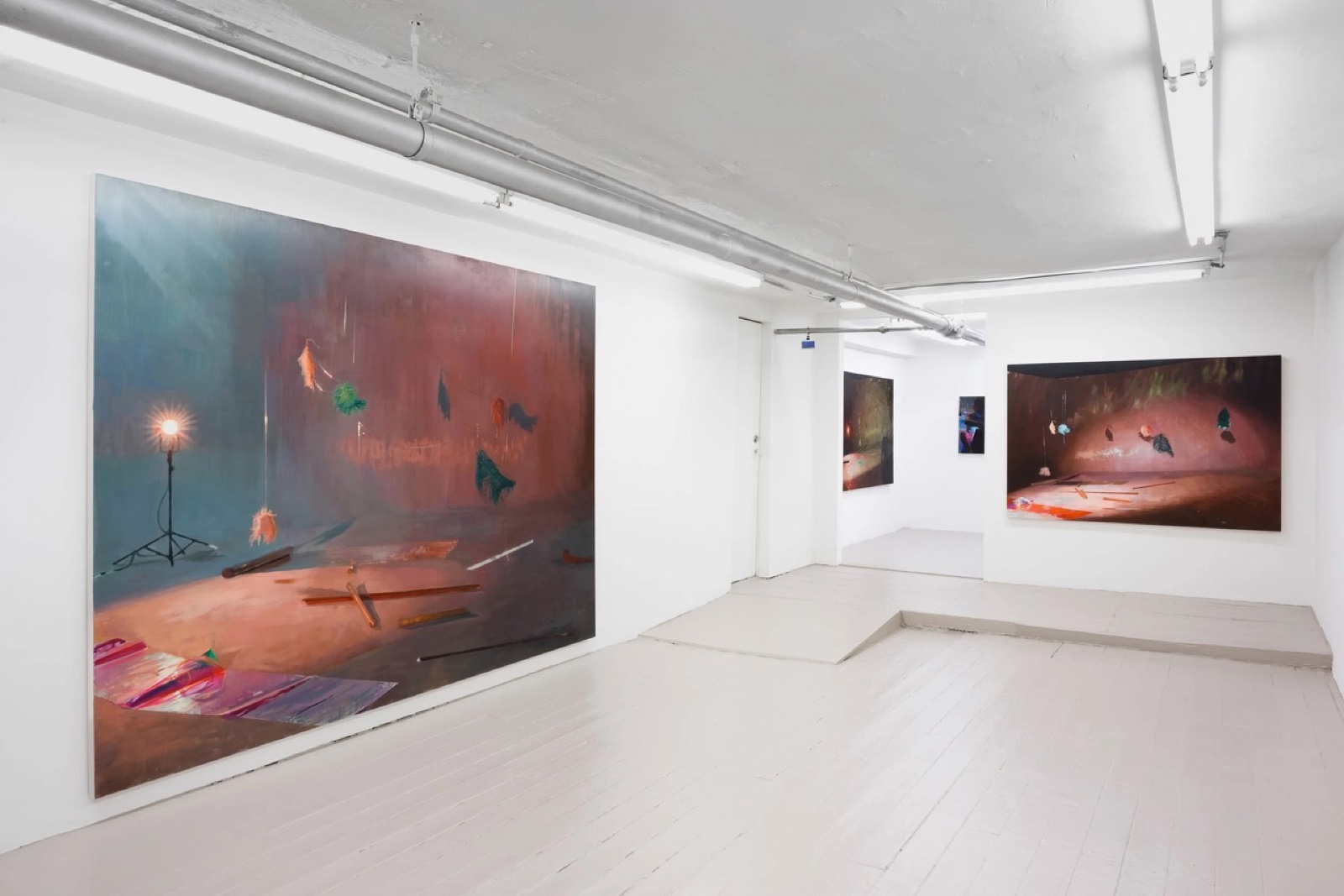
Isaacs has been building sets for her camera since her first show at Theta, in 2023. Then the stage was the glossy floor of her studio shower. The props were rhinestones, plastic studs and ribbon, and the light came from handheld flashlights. The gallery called the resulting paintings "careful degradations of trompe l'oeil." Since then the set has grown into a soundstage, with a cyclorama, a studio lamp and feathers on strings, and the degradation has moved from the objects to the device. In Music is Love, 2026, a large diptych in oil on aluminum, a lamp at the left throws a twelve-pointed starburst. That kind of flare happens only in a lens, and here it is laid down in oil. The seam between the two panels runs straight down the middle of the stage. In The Glade, the artist's poodle, Waggy, crosses as a black blur. He survives only as the camera's failure to hold him. These are Isaacs's best passages, and they share a limit. A flaw painted in oil over months stops being a flaw. It becomes evidence of the painter's attention and vouches for her hand the way a signature does. "Careful degradation" was the right phrase three years ago. Now it names the problem: the care absorbs the degradation. The seam doesn't confess anything. It certifies.
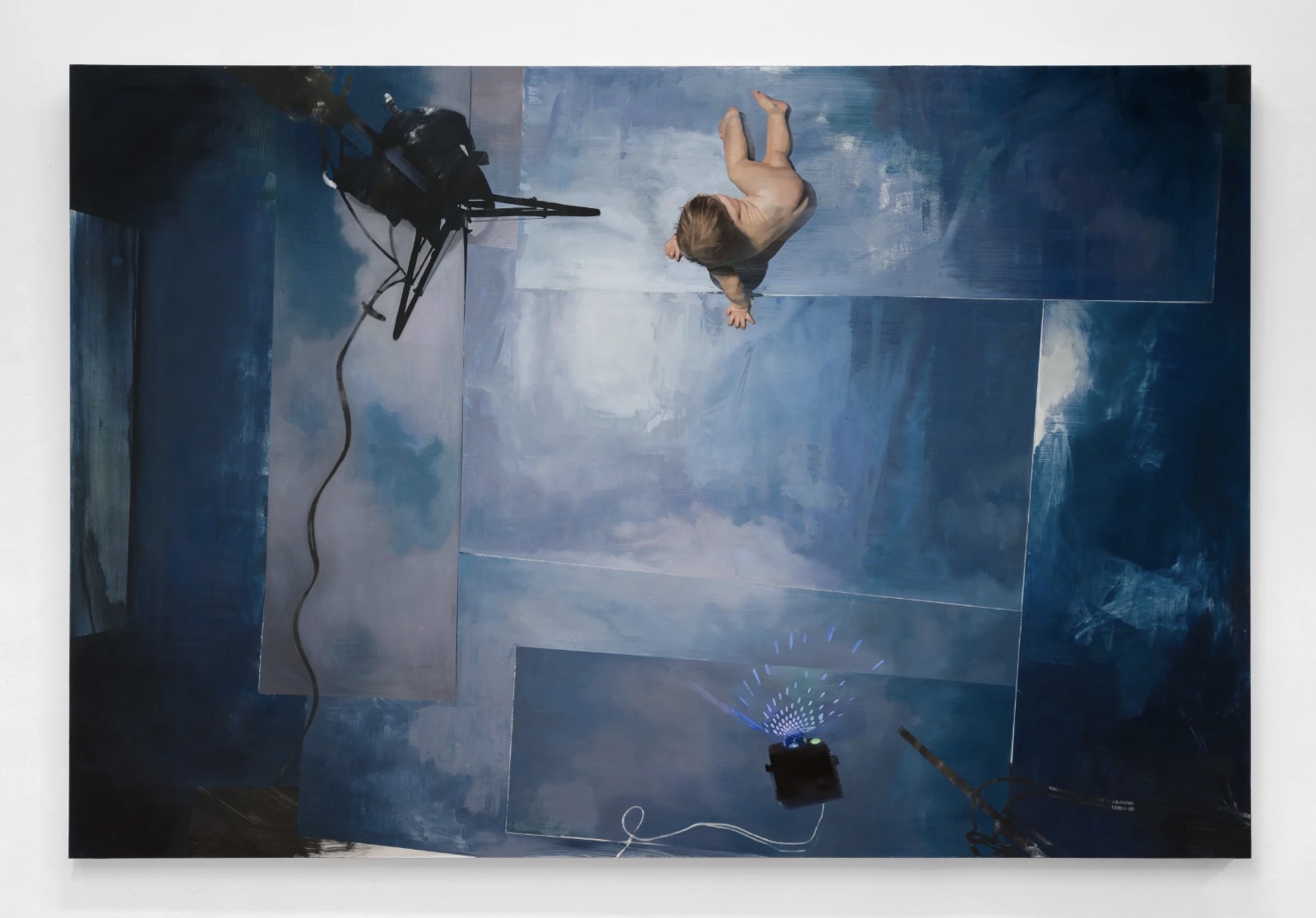
The baby is where this is hardest to miss. In Cloud Editor, the camera looks straight down from the rig. Panels laid across the floor are painted as a cloudy sky. A lamp on its stand reaches in from the upper left, trailing cable, and at the bottom a small black star projector throws a fan of blue light. A naked baby crawls across the clouds toward the edge of a panel. Baroque ceilings put putti in painted skies to be seen from below. Isaacs lays the sky on the floor and looks down at the cherub from the lighting grid. In Cupid, the view drops to floor level: the child sits bent over a black box, and dots of pink, red and blue light land on its chest and knee while its face stays in shadow. This is the audience Baby Einstein was made for, placed inside the picture: rapt, faceless, lit by its toy. It is also the subject least able to hold a pose, the one most likely to leave the camera nothing but a blur. Waggy is allowed that blur. The baby isn't. The spots of light are dabbed on loosely, and the flesh under them is modeled with complete care. The other half of the title points the same way. Mozart was the child his father presented to the courts of Europe, a talent made legible by its staging. The paintings stage the baby the way they stage everything else, and they finish it the way they finish everything else.
The screens get out of that loop because they don't depict the apparatus. They join it. They share the ceiling with the fluorescent tubes and the pipes, and the basement becomes one more lit and rigged room. In the paintings, the baby is shown watching the light. The screens show no one watching. They hang glare on the plumbing and leave the watching to whoever comes downstairs, the only figure in the show Isaacs doesn't finish.